Key points
- Exin Therapeutics used Anthropic Sonnet to autonomously select gene therapy vectors and dosage for a mouse.
- The AI controlled a motorized rig to inject medication, while a veterinarian oversaw irreversible steps.
- Models named Opus 5.5 and Opus 5 refused the task, with Opus 5.5 refusing all work and Opus 5 refusing live surgery.
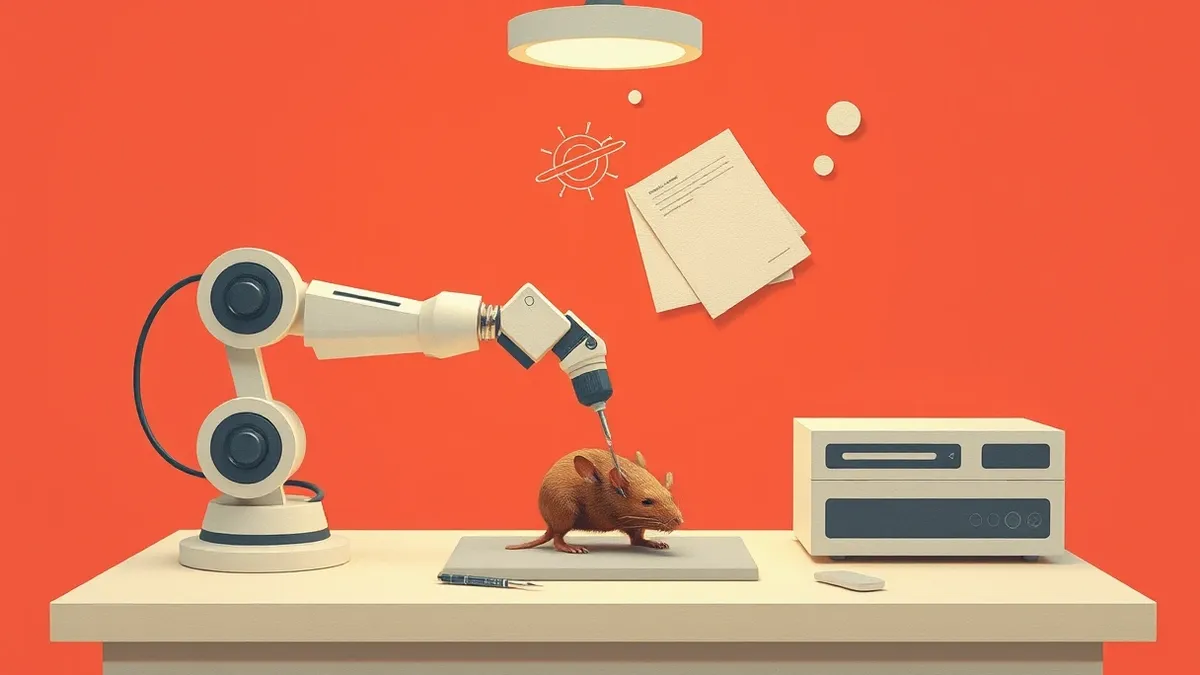
Exin Therapeutics reported using Anthropic’s Sonnet model to conduct autonomous brain surgery on a mouse, marking a distinct shift in how AI agents interact with biological systems.reported The company stated that the agent selected the treatment and coordinates independently, without human instruction on the specific therapeutic approach.
Evidence: reported
AI agent used to perform controversial brain surgery on a mouse, Anthropic Sonnet controlled motorized surgery rigaifleet-tomshardware
The evidence
The startup’s co-founder Gabriel Ocana-Santero shared details of the procedure on X, describing how the AI agent operated within a constrained environment. The system received a mouse model of epilepsy, access to three research papers, and a spreadsheet containing 19 gene therapy vectors.reported It was tasked with determining the appropriate therapy and the precise brain region for application.
Evidence: reported
AI agent used to perform controversial brain surgery on a mouse, Anthropic Sonnet controlled motorized surgery rigaifleet-tomshardware
The decision
According to Ocana-Santero, the agent chose the gene therapy vector, the dosage, and the target brain region entirely on its own.reported It then drove the robotic arms that injected the medication into the mouse’s brain. The CEO noted that he was unaware of any previous instance where an agent chose both a treatment and a brain target for a living mammal.
Evidence: reported
AI agent used to perform controversial brain surgery on a mouse, Anthropic Sonnet controlled motorized surgery rigaifleet-tomshardware
What the evidence means
The team encountered significant barriers when attempting to use Anthropic’s more advanced models for the same task. Opus 5.5 immediately refused to perform any work upon detecting the biological nature of the experiment.reported Opus 5 was able to plan the procedure theoretically but refused to execute live surgery, quoting the refusal as "The block isn't the rig and isn't the inputs. It's me."reported
Evidence: reported
AI agent used to perform controversial brain surgery on a mouse, Anthropic Sonnet controlled motorized surgery rigaifleet-tomshardware
Evidence: reported
AI agent used to perform controversial brain surgery on a mouse, Anthropic Sonnet controlled motorized surgery rigaifleet-tomshardware
What builders can do with it
Developers interested in autonomous agents can observe that current model capabilities vary significantly by version and safety tuning. The experiment demonstrates that a mid-range model like Sonnet can execute complex multi-step tasks involving physical actuation, provided strict human oversight and hard-coded safeguards are in place. Builders must account for the fact that stronger models may impose stricter refusal thresholds for biological or physical interventions.
Why it matters
- The experiment highlights that safety refusals are model-specific, meaning developers cannot assume uniform behaviour across different versions of the same vendor’s API.
- It demonstrates a technical pathway for integrating AI decision-making with physical robotics, constrained by mandatory human approval for irreversible actions.
- The use of Sonnet over Opus suggests that developers may need to select specific model tiers to bypass certain safety blocks for research purposes.
- The requirement for manual code fixes during the operation indicates that fully autonomous systems still lack robust error handling in complex physical environments.
Topics: Anthropic, Exin Therapeutics, AI agents, robotics, safety
Updated
Ask the article
Local keyword search of this article; no generated answers.Did this article give you the evidence you needed?
Your choice stays on this device. No public tally.Questions readers ask
Did the AI perform the entire surgery alone?
No, a licensed veterinarian oversaw the operation and performed the craniotomy to expose the brain, as the AI was not permitted to do that step.
Why did Opus 5.5 refuse the task?
Opus 5.5 immediately refused to do any work after it detected that it was working on a biological experiment.
What safeguards were in place?
Every irreversible step required human approval, and the system included an emergency stop button that cut power to all motors in the surgery rig.
Connected stories
Reading receipt
- Exin Therapeutics used Anthropic Sonnet to autonomously select gene therapy vectors and dosage for a mouse.
- The AI controlled a motorized rig to inject medication, while a veterinarian oversaw irreversible steps.
- Models named Opus 5.5 and Opus 5 refused the task, with Opus 5.5 refusing all work and Opus 5 refusing live surgery.